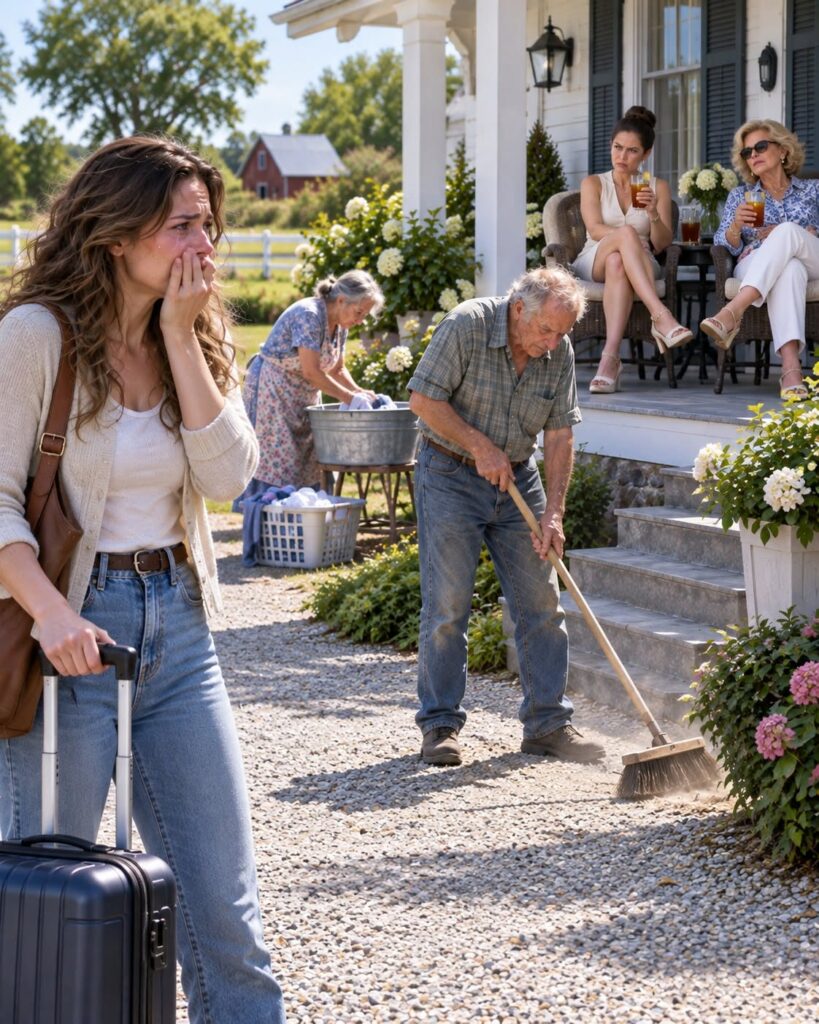
Jessica stepped forward.
“He’s confused.”
Dad flinched.
That small reaction told me more than her words did.
I turned toward him.
“Dad, look at me.
What happened?”
Mom dried her hands on the front of her dress and came slowly across the yard.
She looked smaller than I remembered.
Her hair, once thick and silver, had thinned around her temples.
There was a fading bruise-colored mark near her wrist—not fresh, but unmistakable.
She stopped beside Dad.
“They brought papers,” she said.
Jessica closed her eyes.
“Mom, what papers?”
“They said the county needed updated records because you had put the house in our care.”
She swallowed.
“They told us it was routine.”
“It was not routine,” Dad said.
His hands tightened around the broom handle.
Susan gave an irritated sigh.
“They were forms related to the property.
Nobody forced anyone to sign anything.”
“No,” Dad said.
“You just stood over us until we did.”
“Walter,” Mom whispered.
“What?”
He turned to her, his expression suddenly tired rather than afraid.
“He deserves to know.”
I looked at Jessica.
“What did they sign?”
She glanced toward the road, as though calculating whether she could leave without making matters worse.
Finally, she said, “A power of attorney.”
“For what?”
“Financial matters.”
“That’s not what Dad said.”
“It was part of it.”
“What else?”
Jessica folded her arms.
“Michael, you haven’t been here.
You don’t know what it’s been like managing everything.”
“Managing what?
Their prescriptions?
Because they haven’t received those since February.”
Her mouth tightened.
Susan stepped in.
“Your parents needed help.
The property taxes were due.
The roof needed repairs.
The septic system backed up.
There were expenses you never asked about.”
“I sent money every month.”
“You sent money with instructions,” Susan said.
“Money labeled for medicine.
That doesn’t cover every emergency.”
“So you used it for other things?”
Nobody answered.
The silence stretched across the yard.
Somewhere beyond the fence, a lawn mower started and then stopped.
I looked at my father.
“Did you sign away the house?”
“No,” he said quickly.
“Not exactly.”
The phrase landed like a stone.
“What does that mean?”
Dad lowered his eyes.
“We signed something that gave Jessica authority to borrow against it.”
Jessica shook her head.
“It was a home equity line.
Temporary.
The money was supposed to cover the repairs and your parents’ living expenses.”
“Why didn’t you tell me?”
“You never called.”
“I called every Sunday.”
“You called for ten minutes and asked if they were eating.”
“Because you told me everything was fine.”
“You wanted to believe that.”
The words struck harder because part of them was true.
I had wanted to believe it.
For six years, I had built my life around a picture of my parents safe in this house.
I had treated regular transfers as proof that I was still taking care of them, even from two thousand miles away.
I had asked questions, but I had not asked enough of the right ones.
Had they seen a doctor?
Were they sleeping well?
Who was helping them?
What did the bank statements show?
I had assumed that because Jessica answered the phone and sent occasional photographs, she was helping.
I had mistaken access for trustworthiness.
“What repairs?”
I asked.
Susan looked toward the farmhouse.
“The roof.”
Dad gave a bitter laugh.
“The roof had three loose shingles.”
“The bathroom needed work,” Jessica said.
“It needed a new faucet,” Mom answered.
“Your father’s truck broke down.”
“It was a thirty-year-old truck,” Dad said.
“I fixed it myself.”
“Then there was my mother’s treatment.”
Jessica’s voice cracked around the last words, and for the first time, I saw something beneath her defensiveness that looked like exhaustion.
Susan turned sharply.
“Jessica.”
“No.”
Jessica rubbed both hands over her face.
“No more pretending.”
She looked at me.
“Mom had a serious heart condition.
Her insurance covered some of it, but not everything.
I borrowed money because I thought I could pay it back.”
I said nothing.
“Then the salon failed,” she continued.
“I had employees.
Rent.
Taxes.
I thought I could recover.
I kept thinking one good month would fix everything.”
“And my parents’ money was that good month?”
Her eyes filled, but she did not look away.
“At first, I took only what I needed.
Then I had to replace it before you noticed.
Then I was borrowing to cover what I had already taken.”
Mom stared at her.
“How much?”
I asked.
Jessica’s voice fell to a whisper.
“I don’t know exactly.”
I felt my jaw tighten.
“You don’t know?”
“There were transfers.
Cash withdrawals.
Bills.
I kept records.”
“Where are the records?”
She looked at Susan.
That glance was answer enough.
I turned toward the house.
“Dad, where are the documents?”
He hesitated.
“Dad.”
“In the workshop.”
“Show me.”
Jessica moved in front of him.
“Michael, please don’t make this worse.”
“You made it worse when you let them work outside in ninety-degree heat while you sat on the porch.”
“I was trying to keep everything from collapsing.”
“You let them believe they were losing their home.”
“I didn’t say that.”
“You said the house was taken.”
She went silent.
I stepped around her.
The workshop stood behind the farmhouse, a narrow wooden building Dad had built with his own hands.
The door stuck in summer, and he had always kept a coffee can of nails on the windowsill.
When I was a kid, he taught me how to sand a board without gouging the grain.
Inside, the air smelled of sawdust, oil, and the faint mustiness of old cardboard.
Dad entered behind me.
He moved slowly, one hand resting against the workbench.
“Where are they?”
I asked.
He pointed beneath the bench.
I crouched and pulled out a blue metal tin.
I recognized it immediately.
When I was seventeen, Dad had used it to store the deed to the small house we rented at the time, along with birth certificates, insurance cards, and the title to his truck.
Years later, when I bought this farmhouse, I had placed the closing papers inside and told him, “Keep these somewhere safe.”
He had smiled and said, “Safer than any bank.”
My fingers felt numb as I opened the lid.
Inside were envelopes, receipts, a small brass key, and several folded pages held together with a rubber band.
The top document was a copy of the original closing statement.
The next was a power of attorney, signed by both my parents and notarized six months earlier.
I read the first paragraph twice.
It gave Jessica authority to manage their bank accounts, communicate with creditors, and enter financial agreements on their behalf.
The language was broad.
Too broad.
Beneath it was a loan agreement from a local bank.
The principal amount made my stomach turn.
Fifty-eight thousand dollars.
Collateral: the farmhouse.
The loan had been approved seven months ago.
The payment history showed three missed payments.
The final page was a notice from the bank.
Unless the account was brought current within fourteen days, the matter would be referred for legal action.
I looked up.
“Fourteen days?”
Dad nodded.
“When did you get this?”
“Last week.”
“Why didn’t you call me?”
He looked ashamed.
“Jessica said you would be angry.”
“I am angry.”
“I know.”
“But not at you.”
His eyes shone.
Mom stood in the doorway.
“We thought we could fix it before you found out.”
“You were going to fix a fifty-eight-thousand-dollar loan in two weeks?”
“We didn’t know how much it was,” she said.
“Jessica kept saying the bank had made an error.”
Jessica appeared behind her.
“It wasn’t supposed to become this,” she said.
I lifted the loan papers.
“This says the money was used for home repairs and medical costs.”
“It was.”
“How much went to my parents?”
She stared at the floor.
“Jessica.”
“Maybe twelve thousand.”
“Maybe?”
“Eleven thousand, eight hundred and forty.”
I looked at my mother.
“And the rest?”
Jessica pressed her lips together.
Susan answered for her.
“My treatment.”
“And the salon,” Jessica said quietly.
“Some of it went to the salon.”
My father sat down on an overturned bucket.
He looked less like the man who had raised me and more like someone who had spent years carrying a weight he could no longer lift.
“Why did you sign?”
I asked him.
He rubbed his hands over his knees.
“Because she told us the house was already in danger.”
“What?”
“She said you had stopped making the property payments.”
“There were no property payments.”
“We didn’t know that.”
Mom’s voice trembled.
“Jessica told us the taxes and insurance were behind.
She said if we didn’t sign, the county could take the house.”
I turned to Jessica.
She shook her head.
“I never said the county would take it.”
“You let them believe it.”
“I said the house could be at risk.”
“Because of a loan you took out?”
“I didn’t know how else to keep it.”
I stared at her.
The sentence was so strange that it took me a moment to understand.
“Keep what?”
She looked at the farmhouse through the open door.
“This place,” she said.
“Your parents’ home.
Our family’s home.”
“It was never yours.”
Her face crumpled.
For a second, I thought she might argue.
Instead, she sat down on the workbench and covered her face.
Susan remained standing, rigid and defensive.
“I know what you think,” Jessica said.
“That I used them.
That I’m some awful person who saw a free house and decided to take it.”
“What am I supposed to think?”
“That I was scared.”
“Being scared doesn’t make you entitled to their home.”
“I know.”
The answer stopped me.
Jessica lowered her hands.
“I know,” she repeated.
“But by the time I understood how bad it was, I couldn’t see a way back.
I thought if I kept borrowing, I could get ahead.
Then I thought you’d come home and help once you knew.
But every month I delayed telling you, it became harder.”
“Why didn’t you call me?”
She gave a humorless smile.
“Because you would have asked questions.”
“That’s what family does.”
“Not in my family.”
Susan flinched.
Jessica glanced at her mother.
“Mom had the hospital bills.
She was terrified.
I was terrified.
I made promises I couldn’t keep.”
Susan’s expression hardened again, but her voice was quieter when she spoke.
“I never asked her to take the house.”
“No,” Jessica said.
“You just kept asking for help.”
“I was sick.”
“And I was trying to save you.”
“You were trying to save everyone.”
The words hung in the cramped workshop.
I looked from one woman to the other and saw, beneath the lies and excuses, a relationship built on fear.
Jessica had been trying to rescue her mother, her business, and perhaps her own sense of worth.
Susan had accepted rescue until it became an expectation.
Neither had stopped to ask what their need was costing my parents.
But understanding the reason did not erase the harm.
I returned my attention to the documents.
There was one more page beneath the bank notice.
It was a letter from an attorney.
My name appeared near the top.
Michael Harris.
I read the first sentence, then the second.
The room seemed to narrow around me.
“What is this?”
I asked.
Jessica stood.
Dad reached for the paper, but I held it out of reach.
The letter stated that a title company had received a request to amend the property records.
According to the attached authorization, I had allegedly consented to placing the farmhouse in a family trust managed by Jessica.
My signature appeared at the bottom.
It looked like mine.
Not perfectly.
The first letter was too rounded, and the final stroke was heavier than I usually made it.
But to anyone unfamiliar with my handwriting, it might have passed.
I felt the blood drain from my face.
“I never signed this.”
Jessica stared at the page.
“I didn’t—”
“You knew about this.”
“No.”
“You knew.”
She shook her head rapidly.
“I knew about the power of attorney.
I knew about the loan.
I did not know about that.”
Susan stepped closer.
“What is it?”
I turned the page over.
There was a second attachment: a copy of an email sent from an address bearing my name, authorizing the title company to proceed.
The timestamp was from three months earlier.
I had been in Chicago that day.
I remembered because I had spent most of the afternoon in a conference room negotiating a contract, and my phone records would prove it.
Someone had created an email account that looked almost identical to mine.
Someone had forged my signature.
Someone had tried to place the house under Jessica’s control.
Dad’s breathing became uneven.
“Who did that?” he asked.
No one answered.
Then Mom whispered, “There was a man.”
I looked at her.
“What man?”
She pressed her fingers to her lips.
Jessica turned toward her.
“Mom, what are you talking about?”
“He came here twice,” Mom said.
“He said he worked with the bank.”
“Why didn’t you tell me?”
Jessica asked.
“You told us not to speak to anyone about the papers.”
“I never told you about a man.”
“He knew your name,” Mom said.
“He had a folder.
He said if we didn’t cooperate, we would lose the house.”
I looked down at the forged signature again.
At the bottom of the page was a company name I recognized.
Not a bank.
Not a title company.
A private loan service operating out of a strip mall on the other side of the county.
And beneath the company name was the name of the person who had submitted the documents.
My breath caught.
I knew him.
Not well, but enough.
He had been standing beside Jessica at the farmhouse closing six years earlier, smiling as I handed my parents the keys.
He had called himself a family friend.
Jessica saw recognition cross my face.
“Michael?” she asked.
I lifted my eyes from the document.
“The person who tried to take the house,” I said slowly, “is someone you brought into our family.”
-END OF PART 2, –PRESS NEX PART IN BOTTOM OF PAGE TO READ NEXT PART